Not every rotator cuff tear requires an operation. This surprises many patients who arrive with a scan report describing a tear and assume surgery follows automatically. It does not, and the decision depends far more on the type of tear, your age and your function than on the wording of the report.
Tears divide broadly into two groups. A degenerative tear develops gradually with age as the tendon wears; these are common in later decades and are frequently found in shoulders that are not especially painful. A traumatic tear follows a specific injury — a fall onto an outstretched hand, a heavy lift, a dislocation — in a tendon that was previously working normally.
That distinction matters because a traumatic full-thickness tear in a younger patient, particularly with genuine weakness, is generally repaired and repaired reasonably promptly. Tendon that is left retracted for a long period becomes harder to bring back and the muscle behind it weakens. A degenerative partial tear in an older shoulder, by contrast, often responds well to a structured rehabilitation programme aimed at strengthening the remaining cuff and the surrounding muscles.
Weakness is the finding that changes the conversation. Pain alone can often be managed. Genuine loss of power — being unable to hold the arm out to the side, or a shoulder that simply will not lift — suggests the tendon is no longer doing its job, and that is when repair becomes more compelling.
When repair is favoured vs when rehabilitation is favoured
- ✓Traumatic tear after a specific injury
- ✓Full-thickness tear with true weakness
- ✓Younger, active patient
- ✓Failure of a proper rehabilitation trial
- ✓Progressive loss of power
- →Degenerative, gradual-onset tear
- →Partial-thickness tear
- →Pain without significant weakness
- →Older patient with modest demands
- →Significant medical risk from surgery
Why timing matters in traumatic tears
A tendon torn off the bone tends to retract over time, and the muscle it belongs to gradually loses bulk and is replaced by fat — a change that does not reverse. For that reason a genuine traumatic full-thickness tear in a patient fit for surgery is usually assessed without undue delay. Degenerative tears behave differently and rarely carry the same urgency, which is why the history of how the tear happened is asked about so carefully.
Frequently Asked Questions
Can a rotator cuff tear heal on its own?
A torn tendon does not reattach itself to the bone. However, many people become comfortable and functional without repair, because the remaining cuff muscles and the surrounding shoulder muscles can compensate well. Symptoms improving does not mean the tear has healed — it means the shoulder has adapted.
What happens if a rotator cuff tear is left untreated?
Some tears remain stable and cause little trouble for years. Others enlarge over time, and in traumatic full-thickness tears the tendon may retract while the muscle weakens irreversibly. Periodic review is sensible so that any progression is identified while repair remains straightforward.
How do I know if my tear is partial or full thickness?
An MRI or ultrasound scan distinguishes them. Clinical examination gives a strong indication — full-thickness tears more often produce genuine weakness on specific tests, while partial tears more typically cause pain on resisted movement without true loss of power.
How long is recovery after rotator cuff repair?
A sling is usually worn for around six weeks to protect the repair while the tendon heals to bone. Passive movement begins early under physiotherapy guidance, active movement follows, and strengthening starts later. Most patients are using the shoulder normally for daily tasks by three to four months, with continued improvement over six to twelve months.
Is rotator cuff repair done arthroscopically?
Most repairs are performed arthroscopically through small portals, which allows a thorough inspection of the joint and treatment of associated problems at the same sitting. Very large or complex tears may occasionally require an open or mini-open approach.
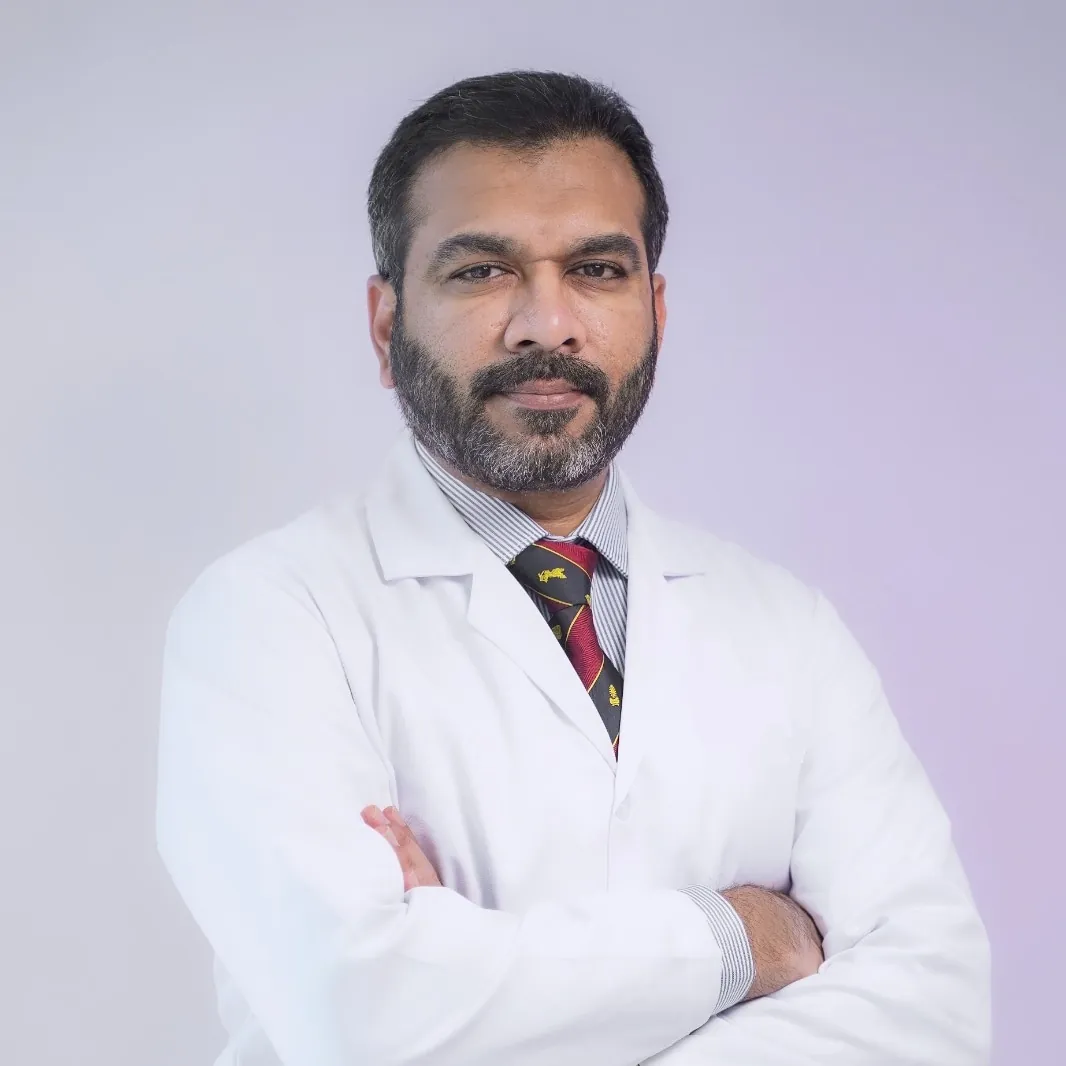
Dr. Chetan M. Dojode
FRCS (Tr&Orth) UK · FEBOT
GMC Specialist Register
Clinic Locations
OSR — OrthoSportsRobotics Clinic / Aarna Clinic, Sahakar Nagar
1182/1, 20th Main Road, A Block,
Bengaluru 560092